Ascott Residence Trust (“ARTSP”; Bloomberg ticker: ART:SP) is navigating an extraordinary downturn in the hospitality industry, as companies cut back on corporate travel and reservations dwindle out of safety concerns. After a healthy performance in the early months of the year, revenue per available unit (“RevPAU”) has declined materially. Nonetheless, ARTSP is well positioned to handle COVID-related shocks due to a prudent capital allocation strategy that has left the trust with a healthy balance sheet.
As more countries open up their economies and normal activity resumes, increased international travel and pent-up demand will drive up occupancy rates for serviced residences. We think an eventual recovery will be first seen in domestic leisure stays. ARTSP could emerge from this crisis with a stronger operating model and larger portfolio as the hospitality trust seeks to create value for its investors.
About Ascott Residence Trust
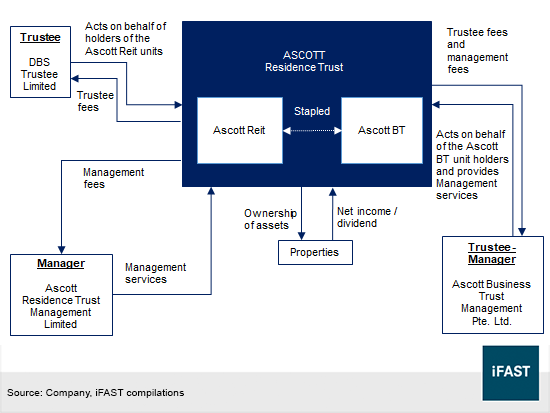
ARTSP is a stapled group comprising Ascott Real Estate Investment Trust (“Ascott REIT”) and Ascott Business Trust (“Ascott BT”). Ascott Residence Trust Management Limited manages Ascott REIT, while Ascott Business Trust Management Pte Ltd is a newly formed entity that acts as the trustee and manager of the Ascott BT (Figure 1). Both the REIT managers are wholly-owned subsidiaries of CapitaLand Limited (“CapitaLand”), which is also the parent company of the sponsor, The Ascott Limited (“Ascott”).
Last year, ARTSP completed the merger with Ascendas Hospitality Trust, enlarging its real estate portfolio to 88 properties. With an operating presence across 39 cities and 15 countries, the trust oversees a range of assets of various accommodation types, including serviced residences, business hotels and rental housing, many of which are suited for travelers who are looking for short- or long-term visits.
The portfolio is well diversified across different regions as about 68% of assets are in Asia Pacific, 20% in Europe and 12% in the Americas. Moving forward, ARTSP intends to focus on Asia Pacific-centric real estate assets as management continues to believe in the long-term growth potential of the region.
As a stapled group with both a REIT and a business trust components, ARTSP has to comply with the aggregate leverage limit applicable to S-REITs. According to the MAS announcement in April this year, the aggregate leverage limit for Singapore REITS should not exceed 50%, which is a comfortable threshold for Ascott REIT given that the gearing ratio for the trust has remained between 34% and 41% from 2011 to 2019.
Figure 1: Trust structure
Since its initial public offering in 2006, Ascott Residence Trust has maintained a 100% distributable income policy, which allows Ascott REIT to qualify for the tax transparency treatment for REITs by the Inland Revenue Authority of Singapore. However, ARTSP highlighted that it may “exercise prudence in review of its distribution payout” in a June presentation to investors, implying that there is a likelihood that payouts to unitholders may be reduced.
About the trust sponsor
Ascott, the trust sponsor, is one of the leading lodging owner-operators worldwide. With a track record spanning over 30 years, Ascott oversees a portfolio covering more than 700 properties with 114,000 lodging units. Total lodging assets, which are held in ARTSP and in private funds, reached approximately S$33.6 billion at the end of 2019.
Ascott has given ARTSP the right of first refusal with regard to the sale of serviced residences or rental housing properties in Europe and the Pan-Asian region. ARTSP may also consider acquiring properties from, or divesting existing assets to, industry partners within the Ascott network of third-party owners. As a member of the CapitaLand group, ARTSP enjoys good access to capital markets at favorable terms.
Revenue recognition
Group revenue is recognized through a combination of master leases and management contracts. 34 properties operating under master lease arrangements (as of end-2019) are situated in Australia, France, Germany, Japan, South Korea and Singapore. Properties under management contracts with minimum guaranteed income are located in the UK, Belgium and Spain.
As at 31 Dec 19, 45 managed properties are on management contracts without minimum guaranteed income. Under these management contracts, the income stream is dependent on the revenue per available unit (“RevPAU”) of the properties.
Seven properties are under management contracts with minimum guaranteed income, with a weighted remaining tenure of two years. Under the terms of such contracts, property operators provide a minimum income guarantee to ARTSP over the term of the agreement, which gives a stable income stream to the trust.
Master leases
Contracts with master leases have a longer weighted tenure of eight years. Rentals tagged to these master leases are revised according to inflation indices representing the cost of construction or commercial rental prices. Master leases in Australia, for instance, are subject to annual revisions until the next market review, while master leases for other properties in Asia have a variable price component, in addition to a base rental rate.
Figure 2: Master lease expiry profile
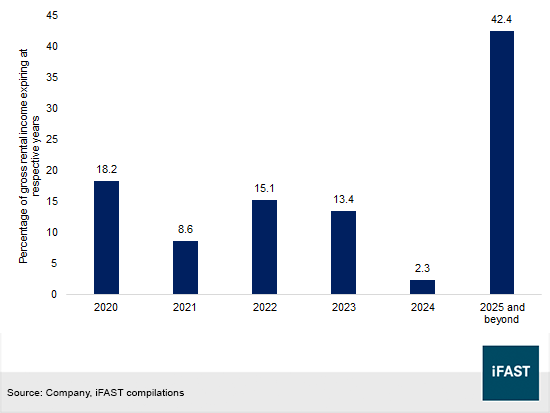
There were no master leases renewed last year, and customers may not renew their leases this year as demand is comparatively weaker. For example, WBF Hotel & Resorts, master lessee of Hotel WBF Kitasemba East, Hotel Kitasemba West and Hotel WBF Honmachi in Osaka, filed for civil rehabilitation on 27 Apr 20. Under the court proceedings, the hotel operator may continue or terminate the master lease with ARTSP. The latter will result in a decline in revenue from master leases in 2020, affecting rental income.
Revenue breakdown
Taking into account the potential loss of income from WBF and assuming no master lease renewals this year (~18% of gross rental income from master leases), the decline in gross rental income could reach S$18m – which is nearly 25% of rental revenue from master leases. To put it into perspective, ARTSP made S$17.9m of rental income from master leases in the quarter ending 31 Dec 19 (“4Q19”), and S$74.6m during 2019 (Table 1).
Table 1: Revenue by contract type
|
|
4Q19 |
Percentage of quarterly total |
2019 |
Percentage of yearly total |
|
Master leases |
17.9 |
13% |
74.6 |
14% |
|
Management contracts with minimum guaranteed income |
20.5 |
15% |
81.1 |
16% |
|
Management contracts |
95.7 |
71% |
359.2 |
70% |
|
Source: Company, iFAST compilations |
||||
Group revenue is largely driven by income from management contracts, which accounted for around 86% of total revenue in both 4Q19 and 2019. Income from management contracts are less stable than those from master leases as it is determined by trends in RevPAUs.
RevPAUs have mostly declined on a year-on-year basis both in 4Q19 and 1Q20 (Table 2), but we think that occupancies may have stabilized and found a bottom in April. In addition, average daily rates may be slightly lower, but average portfolio occupancy is recovering and remain above the breakeven level.
Table 2: RevPAU performance by geography
|
|
4Q19 YoY change |
1Q20 YoY change |
|
Australia |
-13% |
-28% |
|
China |
-7% |
-31% |
|
Indonesia |
12% |
-25%* |
|
Japan |
-3% |
-37% |
|
Malaysia |
-10% |
-25%* |
|
The Philippines |
9% |
-23%* |
|
Singapore |
8% |
-30% |
|
The US |
-4% |
-22% |
|
Vietnam |
9% |
-20% |
|
Source: Company, HVS Research, iFAST compilations *Represents YoY change in the country’s RevPAR (March 2020) as reported by HVS Research |
||
Hotels are reopening in various countries with the resumption of within-border travel activity. New York City, which accounted for 33% of ARTSP’s management contract revenue in 4Q19, has begun its reopening in June. Properties in the US were less affected as hotels were considered essential services and have remained operational during the virus outbreak, providing accommodation to healthcare employees.
Meanwhile Japan, which accounted for 15% of management contract revenue, had experienced challenging operating conditions, but the country is opening up its borders to selected countries that will lift business accommodation demand. China, representing 13% of management contract revenue, had eased movement restrictions, and domestic leisure demand had recovered with the relaxation of lockdown measures. Data consultant STR reported an increase in China hotel occupancies from 14% in February to about 50% in May. Overall, these gradual re-openings are positive developments for ARTSP.
Top-line growth have decreased but cash flows are healthy
Fourth-quarter revenue of 2019 dropped by 2% as compared to 4Q18, mainly due to the absence of contribution from Ascott Raffles Place Singapore and Somerset West Lake Hanoi following their divestments. Gross profit increased by S$1.9m with the adoption of FRS 116 Leases, but on a same store basis and excluding the FRS 116 adjustment, gross profit actually fell by S$1.7m.
Finance costs were higher in 4Q19 owing to a S$2.8m interest expense from lease liability, with the adoption of FRS 116. Excluding the FRS 116 adjustment, finance costs would have dropped by S$2.0m from lower interest rates and the repayment of bank loans with divestment proceeds from Ascott Raffles Place Singapore.
The trust registered higher earnings for 4Q19 from a year ago. Net income before changes in fair value of financial derivatives, investment properties and assets held for sale grew from S$40.6m in 4Q18 to S$43.2m in 4Q19. Total return for the period after tax increased 69% to S$56.8m.
Cash flows for the trust remained steady, with operating profit before working capital changes nearly unchanged at S$65.4m in 4Q19. Cash generated from operations improved slightly from S$67.6m to S$69.1m.
There is an adequate amount of liquidity available to the hospitality trust. As at the first quarter of this year (“1Q20”), ARTSP maintained about S$300m in cash and cash equivalents. The company reported that S$425 million of credit facilities (out of which S$200m are committed) are accessible to the group.
In the unlikely scenario that the trust earns zero revenue, management guided that its cash and committed credit facilities are enough to cover nearly two years of fixed expenses (4Q19: ~S$65m). Furthermore, ARTSP is expected to receive S$163m in cash proceeds from the divestment of partial gross floor area at Somerset Liang Court Singapore in July 2020.
Credit profile remains in good shape
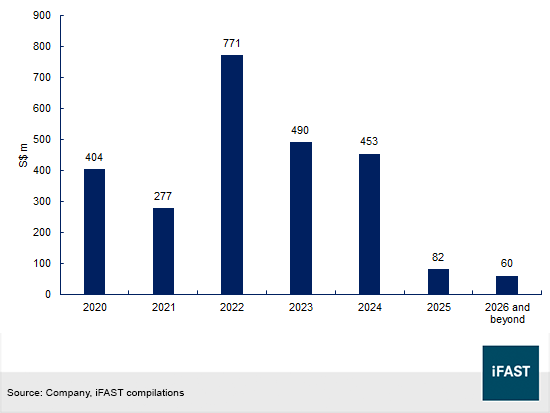
With S$300m of cash, S$425m of undrawn credit lines and S$404m of short-term borrowings, ARTSP should not have difficulty meeting payment obligations in 2020. Lenders are also likely to be supportive if the trust wishes to refinance its current bank loans. The trust keeps a well-staggered debt maturity profile (Figure 3), while retaining a low gearing and healthy interest-servicing ability.
Figure 3: Debt maturity profile as of 1Q20
ARTSP’s reported gearing (debt over assets) was 35.4% and interest cover multiple was 5.1x (twelve-month trailing) at 1Q20. These metrics represent a slight deterioration from 2019’s 33.6% gearing and 5.6x interest cover.
Adjusted total borrowings, otherwise defined as lease liabilities, financial liabilities, perpetual securities and guarantees added to S$3,247m in 2019. In determining our adjusted gearing ratio, we included the value of ARTSP’s perpetual securities and corporate guarantees provided by Ascott BT to banks amounting to S$209m, for unsecured bank loans undertaken by subsidiaries in Australia and South Korea. When expressed as a percentage of total assets, the group’s adjusted gearing ratio was estimated to be 43.7% in 2019. This is a relatively high level for S-REITs but ARTSP still has a debt headroom of S$1.25 billion and S$2.10 billion before reaching the respective 45% and 50% aggregate leverage limits.
The trust has a respectable ability to service interest expense. Taking the distributions to perpetual securities as interest costs, ARTSP’s EBIT-to-interest multiple was 3.6x for 2019. Following the company’s disclosures, EBITDA (earnings before net interest expense, taxes, depreciation and amortization)—before change in fair value of financial derivatives, change in fair value of investment properties, investment property under development and assets held for sale, and foreign exchange differences—over net interest expense had been increasing over the last few years, rising from 4.1x in 2015 to 5.6x in 2019.
Non-call event
On 29 May, ARTSP notified the Singapore exchange that it would skip the first call on the ARTSP 4.680% Perpetual Corp (SGD), which is first callable on 30 Jun 20 and every six months thereafter. At the end of June, the coupon rate of the perp will reset to the sum of the prevailing five-year SGD Swap Offer Rate + 250 basis points (“bps”).
The exchange filing cited longer term interests and current macroeconomic headwinds as factors that led to a non-call decision. According to ARTSP, drawing down on debt to redeem the perps will increase leverage and reduce the debt headroom available for acquisition opportunities. In addition, management noted that property valuations could soften on the back of weaker operating performance, potentially lifting the trust’s gearing ratio further.
A higher gearing may lower ARTSP’s credit rating, which is currently at an investment-grade level (BBB by Fitch Ratings). The recent weakness in earnings may continue and, combined with higher leverage, may cause the rating agency to downgrade its views on the hospitality trust, which would affect future borrowing terms and its ability to tap capital markets.
Considering the fluid nature of the ongoing COVID-19 situation and uncertainty of a full recovery, ARTSP has decided to conserve liquidity by not exercising the call option on the perp. Drawing down on credit facilities to pay off the perpetual is not an option at this point, as the funds may be required for future downturns or acquisitions. Once credit conditions become more favorable for the issuance of perpetual securities, the trust will contemplate redeeming the 4.68% perp.
Subsequent market reaction
Non-call decisions help issuers to preserve liquidity, but companies also need to balance this consideration against other factors such as the reputational impact of a non-call and the need for continued access to perp issuance, as perps do not fall under the calculation of S-REITs’ leverage ratios.
ARTSP’s decision not to redeem its 4.68% security had likely contributed to a pullback in bid prices for SGD perpetual notes with call dates in 2020 (Table 3). However, the drop in prices had evidently been more significant for REIT perps. Even though Keppel REIT and Ascendas REIT have the means to redeem their perpetual notes callable this year, the current low bid prices highlight the market’s insecurity about the REITs’ willingness to redeem the perps.
Table 3: SGD perps callable in 2020
|
Ticker |
First Call Date |
Amount outstanding (SGD m) |
(a) Indicative bid price on 29 May |
(b) Indicative bid price on 3 June (immediate market reaction) |
(c) Indicative bid price on 23 June |
Difference in bid price between 29 May and 23 Jun (c) – (a) |
|
ARTSP 4.680% Perpetual Corp (SGD) |
30/6/2020 |
250 |
96.5 |
93.5 |
94.6 |
-1.9 |
|
BAERVX 5.900% Perpetual Corp (SGD) |
18/11/2020 |
450 |
98.2 |
97.2 |
97.3 |
-0.9 |
|
CELSP 3.900% Perpetual Corp (SGD) |
19/10/2020 |
240 |
96.1 |
95.9 |
97.4 |
1.3 |
|
DBSSP 4.700% Perp/Callable 2020 Pref (SGD) - Retail |
22/11/2020 |
800 |
100.4 |
100.3 |
100.3 |
-0.1 |
|
KREITS 4.980% Perpetual Corp (SGD) |
20/11/2020 |
150 |
98.3 |
95.8 |
97.0 |
-1.3 |
|
WINGTA 4.350% Perpetual Corp (SGD) |
24/8/2020 |
260 |
94.7 |
94.7 |
95.7 |
1.0 |
|
AREIT 4.750% Perpetual Corp (SGD) |
14/10/2020 |
300 |
99.9 |
96.9 |
98.9 |
-1.0 |
|
OCBCSP 3.800% Perpetual Corp (SGD) |
25/8/2020 |
500 |
100.1 |
100.1 |
99.9 |
-0.2 |
|
Source: Bloomberg Finance L.P., iFAST compilations |
||||||
Bond valuation
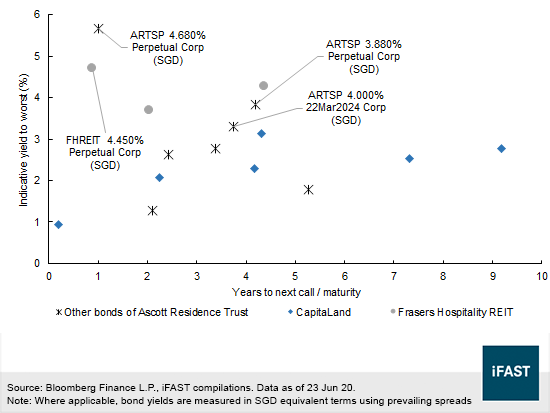
We think the ARTSP 4.680% Perpetual Corp (SGD) is attractively priced among comparable credits given its better valuation (Figure 4), the issuer’s diversified geographic exposure, access to liquidity and good interest servicing ability. Investors who are keen on bullet bonds instead may consider investing in the ARTSP 4.000% 22Mar2024 Corp (SGD).
The valuation for the ARTSP 4.68% perp in Figure 4 is based on an ask price of 97.5 and assumed call date of 30 Jun 21. With a yield to call (30 Jun 21) of 5.66% as at 23 Jun 20, we prefer the ARTSP 4.68% perp over the FHREIT 4.450% Perpetual Corp (SGD) and ARTSP 3.880% Perpetual Corp (SGD), which have lower yields to next call of 4.70% and 3.83% respectively.
Figure 4: Relative valuation
Frasers Hospitality Real Estate Investment Trust, or FHREIT, is part of Frasers Hospitality Trust (“FHT”), which manages a portfolio of 15 properties, comprising nine hotels and six serviced residences. As shown in Table 4, when compared to ARTSP, FHT has a higher interest coverage multiple and similar gearing ratio, but it operates on a smaller scale and is less diversified.
Table 4: Selected financial metrics for ARTSP vs FHT as at 4Q19
|
|
ARTSP |
FHT |
|
Number of properties |
88 |
15 |
|
Country segments |
Singapore, Australia, Belgium, China, France, Germany, Indonesia, Japan, Malaysia, Philippines, Spain, UK, US, Vietnam |
Australia, Singapore, UK, Malaysia, Japan, Germany |
|
Revenue (S$ ‘000) |
134,101 |
42,367 |
|
Estimated EBIT / Finance costs |
4.4x |
5.5x |
|
Gearing ratio |
43.7% |
44.0% |
|
Source: Company filings, iFAST compilations |
||
Even though the two issuers have the ability to redeem their perpetual securities in our view, the ongoing weakness in the hospitality space could dampen their willingness to do so. Prices could fall further if the perps were to be extended, but that would also lead to a more appealing valuation. As an illustration (Table 5), the yield to call on the ARTSP 4.68% perps, assuming a call date of 30 Jun 21, would rise to 8.4% if the ask price drops to 95 – an interesting investment opportunity for an issuer with a BBB credit rating.
Table 5: Yields to call for ARTSP 4.68% perp assuming different call dates and prices
|
Price |
30 Dec 20 |
30 Jun 21 |
30 Dec 21 |
30 Jun 22 |
|
105 |
-6.3 |
-1.7 |
-0.2 |
0.6 |
|
104 |
-4.4 |
-0.8 |
0.5 |
1.1 |
|
103 |
-2.6 |
0.2 |
1.1 |
1.6 |
|
102 |
-0.7 |
1.1 |
1.8 |
2.1 |
|
101 |
1.2 |
2.1 |
2.4 |
2.6 |
|
100 |
3.1 |
3.1 |
3.1 |
3.1 |
|
99 |
5.1 |
4.1 |
3.8 |
3.6 |
|
98 |
7.2 |
5.2 |
4.5 |
4.2 |
|
97 |
9.2 |
6.2 |
5.2 |
4.7 |
|
96 |
11.4 |
7.3 |
5.9 |
5.2 |
|
95 |
13.5 |
8.4 |
6.6 |
5.8 |
|
94 |
15.7 |
9.5 |
7.4 |
6.3 |
|
93 |
18.0 |
10.6 |
8.1 |
6.9 |
|
92 |
20.3 |
11.7 |
8.9 |
7.5 |
|
91 |
22.6 |
12.9 |
9.6 |
8.0 |
|
90 |
25.0 |
14.1 |
10.4 |
8.6 |
|
Source: Bloomberg Finance L.P., iFAST compilations. Indicative yields based on SGD swap rates as at 23 Jun 20. |
||||
From another perspective, the high I-spread (credit spread over SGD swaps) of 442 bps for the ARTSP 4.68% note provides yet another reason to invest in the perp, when compared against other bonds such as the HPLSP 3.850% 27May2021 Corp (SGD) (I-spread: 236 bps). We compared against the latter because it has a similar issue date and matures around June next year, which coincides with our assumed call date for the 4.68% perps.
In closing
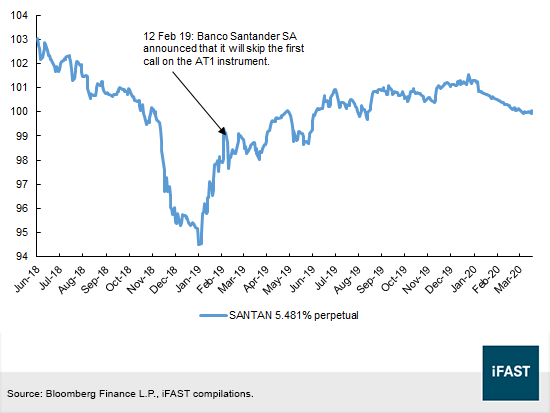
Even though it is broadly interpreted as a negative outcome for perp investors, a non-call announcement may not always lead to a sell-off. When Banco Santander did not exercise the option to call its 6.25% AT1 note last year (the coupon dropped to 5.481% thereafter), bid prices broadly held above the 98 level and continued its upward trend up till March this year, when the note was eventually redeemed (Figure 5). On hindsight, Santander note holders would have been better off if they held on to their AT1s.
Figure 5: Bid prices of the SANTAN 5.481% perp
Macro headwinds may persist in the near term, but we think Ascott Residence Trust retains a manageable credit profile. As hospitality demand improves and essential travel activity picks up, we think investors should consider investing in the 4.68% perp and ARTSP 4% ‘24s. The trust continues to enjoy strong sponsor support, broad revenue streams, positive cash flows and access to sufficient liquidity.
Declaration:
For specific disclosure, at the time of publication of this report, IFPL (via its connected and associated entities) and the analyst who produced this report hold a NIL position in the abovementioned securities.